
History
From the Stone Age to Today
The Origins of Boomerangs
The boomerang is a story that begins during the Paleolithic era, 11,650 years ago. One of the oldest examples of a boomerang was discovered in Obrazowa Cave in the Carpathian Mountains of Poland. It was a curved object carved from mammoth tusk that dated between 23,000 to 30,000 years ago. Another example, archaeologists uncovered several wooden boomerangs in a peat bog at Wyrie Swamp in South Australia, dating back to 8000 BCE. Even older than the object, were the pictures. Rock art, estimated to be about 20,000 years old, discovered in the Kimberly region in Northwestern Australia depicts people wielding boomerangs.
Despite popular belief, the boomerang and boomerang-like artifacts are not confined to Australia. Hunting sticks were found all around Europe dating back to the stone age.
In the Netherlands, wooden throwing sticks were dated to the first century BCE, while other throwing sticks were found among the treasures of Pharaoh Tutankhamun from 1330 BCE. Experiments with replicas of Egyptian throw sticks have shown that a handful of them could function as returning boomerangs, suggesting that by the time of the pharaohs, the aerodynamic principles of a returning boomerang were understood outside Australia as well.
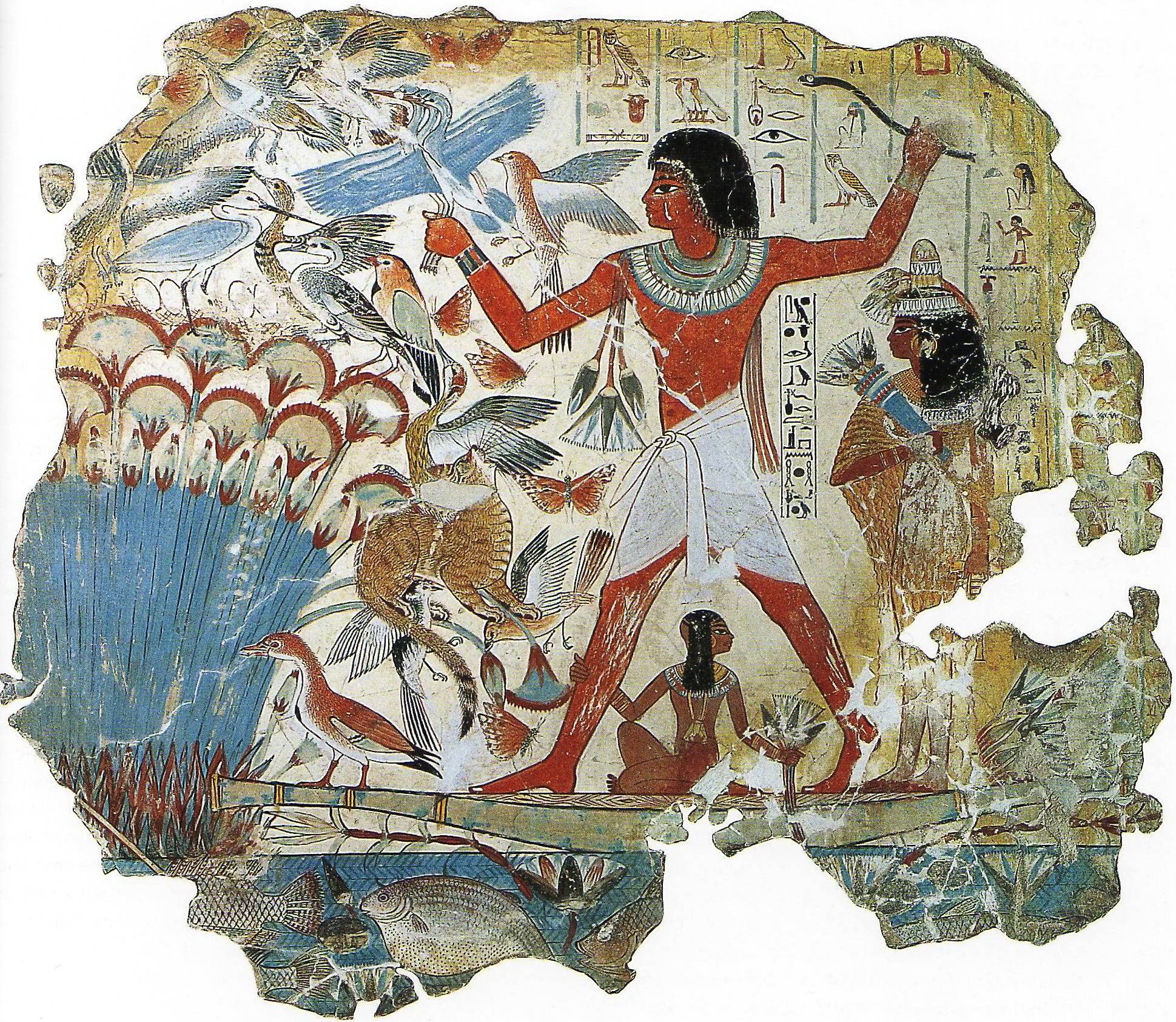
The “Hunting in the Marshes” fresco from the Tomb of Nebamun (ca. 1350 B.C.) depicts the scribe Nebamun using a snake-headed throwing stick to hunt waterfowl in the Nile marshes. This scene, displayed in the British Museum.
Returning vs Non-Returning Boomerangs
There are two kinds of boomerangs, returning, and non-returning boomerangs (often called throwing sticks, kylies, or war/hunting boomerangs). The difference between the two lies in their design and utilization of the laws of physics.
A returning boomerang is typically thin, light weight, and has wings with an airfoil similar to that of an airplane. When thrown, it generates uneven aerodynamic lift, tracing a curved flight path that eventually makes its way back to the thrower. This ingenious design makes the returning boomerang one of the earliest human-made objects capable of sustained heavier-than-air flight, predating the invention of the airplane by millennia. With the returning boomerang’s elliptical flight path, it was likely used more for sport or ceremonies rather than as a weapon or hunting tool. But regardless, it can still hurt if you’re hit by one.
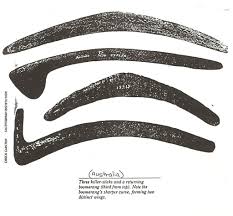
Both Returning and Non-Returning Boomerangs – The top two were likely non-returning, used for hunting. While the bottom two were likely returning boomerangs used for sport.
In contrast, the non-returning boomerangs are heavier, flatter, and designed to fly straight and hit hard. The non-returning boomerang could be quite large, with some being over 1.5 meters on the longer end of the spectrum. These things could also be quite heavy, with some weighing over several kilograms. Instead of traveling the oval shaped flight path that returning boomerang throwers are more used to, throwing sticks traveled in a direct trajectory, being capable of felling game at distances of 50-100 meters in a single throw. With a lot of power behind a lot of flying mass, it could easily kill smaller creatures like rabbits or birds, or seriously injure a larger animal. A well placed shot could break the legs of a kangaroo or the neck of an emu.
The Significance of Boomerangs with the Aboriginal Peoples of Australia
For many indigenous cultures, the boomerangs are far more than hunting tools, they are saturated with cultural meaning and practical utility. This is especially true for the Aboriginal peoples of Australia, for whom the boomerang is an iconic symbol. In some Aboriginal Australian legends known as the Dreaming, ancestral heroes threw giant boomerangs that sculpted the landscape, forming rivers, mountains, and other landforms as they whirled through the air. The Dreaming is essentially the Australian Aboriginal equivalent of Greek or Norse Mythology, as it explains their world views and the origin of the universe. Such a narrative conveys the idea that the boomerang existed since the dawn of time, and underscores its status as a link between people, their ancestors, and the land.
Beyond mythology, boomerangs served a myriad of functions in Aboriginal life. A single, durable, well-crafted Kylie could be all one would need to survive. It could be used for digging roots out of the ground, or cutting/scraping for woodworking purposes, or for starting fires by using the friction between your boomerang and a much softer wood. Of course, the classic use for the Kylie was hunting. The Aboriginal Australians hunted a variety of animals, from large kangaroos to small birds. There were even different throwing techniques to match the kind of prey you would hunt: you could throw the boomerang straight at the target or ricochet it off the ground to hit an animal from below.
The Kylie boomerang was also used for domestic purposes like warfare or law enforcement. Medium-sized throwing sticks were thrown at enemies in inter-tribal conflicts, and could cause serious injury or even death. Large boomerangs (up to two meters long) were used as hand clubs in close quarters combat, demonstrating the versatility of the tool. The very word “boomerang” in one Aboriginal language of New South Wales originally referred to a kind of fighting club, indicating how fluid the line between thrown weapon and hand weapon could be.
Boomerangs weren’t just survival tools or weapons of warfare, but also had ceremonial and artistic uses. Australians frequently carved and painted boomerangs with intricate designs connected to tribal stories, totems, and kinship. Believe it or not, the boomerang was also a musical instrument, where a pair of boomerangs were clapped together in rhythmic percussion to accompany songs and chants. In initiation ceremonies or corroborees (gatherings), performers might carry boomerangs as props symbolizing heritage and survival. The act of a boomerang returning could itself be imbued with symbolic meaning, perhaps an echo of spiritual return or the cyclical nature of life.
Spread and Adaptation in Other Cultures
Despite the global occurrence of throwing sticks, the returning boomerang remained primarily an Australian specialty until modern times. There is no clear evidence that the idea of the returning boomerang spread through contact or trading between other cultures and civilizations; rather, it appears to have been discovered independently in each civilization. In ancient Egypt, as noted, the pharaohs like Tutankhamun amassed collections of throwing sticks. Egyptian nobles famously hunted waterfowl along the Nile by flinging Kylies that would skim over the marshes. Most of these were straight-flying clubs, but intriguing, several examples found in tombs have the characteristic twist and balance of returning boomerangs. Tests with replicas have shown that at least a few Egyptian boomerangs could indeed loop back in flight. Whether the returning trait was an intentional design by the Egyptians or a coincidental effect is still studied by historians of technology. What is clear is that boomerangs (returning or not) in Egypt were associated with the elite sport of hunting and were even carried symbolically.
In Europe, the use of boomerang-like weapons likely died out as projectile weapons like bows and arrows evolved. The discovery in Poland of the Paleolithic mammoth-tusk boomerang shows that Ice Age Europeans knew the concept, and finds in the Netherlands indicate that by the Iron Age (circa 1st century BCE) some northern Europeans still made curved throwing sticks. However, there is no record of classical civilizations (Greeks, Romans) using boomerangs, suggesting the tool was not widely diffused through the Old World in historical times.
Meanwhile, in other parts of the world, the throwing stick remained in use. In other parts of Africa, hunters used throwing clubs (e.g., the Nubian throwstick or the East African rungu), though these were generally straight or knobbed sticks rather than curved returning boomerangs. In North America, tribes such as the Hopi of the Southwest employed rabbit sticks in hunting and also as toys in races (throwing them for distance), but again these did not return. Australia, isolated by ocean, became the place where the boomerang’s returning form was preserved and refined over thousands of years.
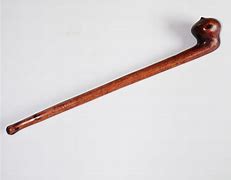
East African Masai Rungu
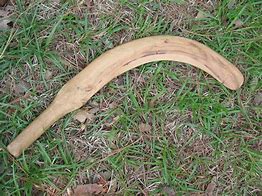
Rabbit Stick
European exploration in the modern era reintroduced the boomerang to global audiences. When British colonists and explorers arrived in Australia in the late 18th and early 19th centuries, they were astonished by the local Aboriginal peoples’ skill with the boomerang. The first known eyewitness account by a European of a boomerang in action dates to 1804 at Farm Cove (Port Jackson, Sydney). Onlookers observed an Aboriginal warrior throw a “bent, edged waddy” that spun through the air and struck an opponent, then “rebounded” some 70 yards away. This report, published in the Sydney Gazette, described the weapon’s motion with fascination, and marks the moment the boomerang entered the written record of the colonial world. By 1827, the term “boomerang” (adapted from an Aboriginal Dharug-language word, possibly boomerrang or bou-mar-rang) had entered the English lexicon to describe these remarkable curved throwing sticks.
Through the 19th century, boomerangs became sought-after curiosities in Europe and America. Australian Aboriginal people, recognizing this interest, often bartered boomerangs to sailors and settlers. By the mid-1800s, boomerangs could be found in museums, private collections, and even at international exhibitions. For instance, ethnographic displays in Europe frequently included boomerangs as exotic artifacts from Australia, captivating the public imagination. This growing fascination sometimes blurred the original cultural context – boomerangs were seen as novel toys or trophies rather than vital elements of Aboriginal life. Nonetheless, by the early 20th century the boomerang was an internationally recognized symbol of Australia and, more broadly, a symbol of the ingenuity of Indigenous technologies. The image of the boomerang started appearing in advertising and popular culture (often with the idea that “what goes around comes around”). In fact, the boomerang’s ability to return made it a convenient metaphor and marketing symbol for travel companies and other businesses promising that customers would “come back”.
Introduction of Boomerangs into the US
The United States first encountered boomerangs through this wave of 19th-century global curiosity. American sailors and travelers collected boomerangs during visits to Australia, and some early examples made their way into American museums. By the late 1800s, public demonstrations of boomerang throwing were occasionally given as entertainment. For example, during world’s fairs and expositions, Aboriginal performers or European enthusiasts would show off boomerang throws to amazed crowds (reports from the 1893 Chicago World’s Fair, for instance, mention such displays). The boomerang’s distinctive flight even found its way into early American literature and cartoons, establishing it as a familiar exotic object by the early 20th century.
It wasn’t until the mid-20th century, however, that boomerang throwing in the U.S. shifted from mere novelty to an organized sport and hobby. A key turning point was a 1968 article in Scientific American magazine that explained the science of how boomerangs work. This article ignited new interest among American readers, revealing the physics behind the boomerang’s returning flight and dispelling myths that boomerangs were impossible magic. Around the same time, the Smithsonian Institution in Washington, D.C. began sponsoring annual workshops on boomerang making and throwing, introducing the craft to a new generation of enthusiasts. By the late 1960s and early 1970s, small boomerang clubs were forming in the U.S., paralleling similar developments in Europe.
The 1970s saw the formalization of boomerang competitions. In 1975, the United States hosted what is often cited as the first international boomerang tournament – held in Seattle, Washington – where throwers from several countries competed under standardized rules. This event marked the emergence of boomerang throwing as a serious sport in the U.S., complete with events for accuracy, distance, and trick catching. American throwers became innovators in boomerang design during this period, experimenting with new shapes and materials to gain competitive edges.
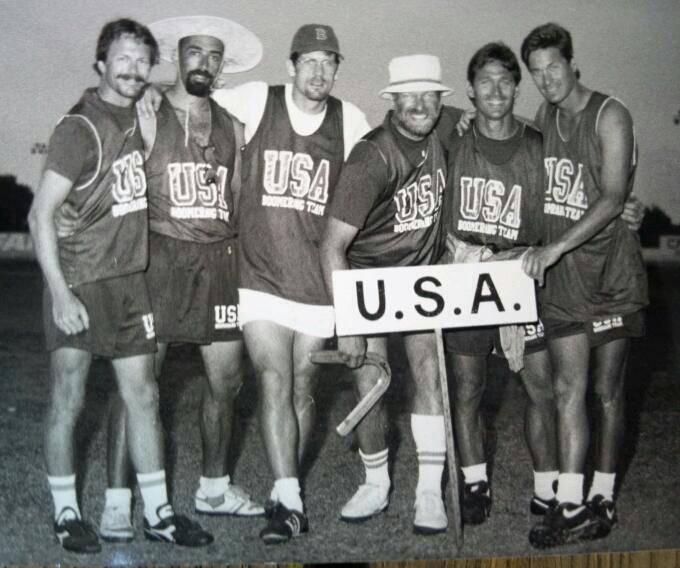
Team USA: Photo featuring John Flynn, John Mole Man Anthony, Casey Larrance, Chet Snouffer, and Gregg Snouffer, some of the original members of the first ever American Boomerang Team (or Team USA).
Enthusiasm for the sport led to the founding of the United States Boomerang Association (USBA) in 1980, a national body devoted to promoting boomerang sport, science, and art. The USBA helped coordinate regional and national championships, and U.S. throwers soon began excelling on the world stage. Notably, American athletes like Chet Snouffer won multiple world championships in the late 1980s and 1990s, bringing international prestige to the U.S. boomerang community. Certain U.S. locales became hotbeds of boomerang activity – for instance, Delaware, Ohio, hosted numerous national tournaments and even a world record for boomerang duration flight (Maximum Time Aloft), earning a reputation in boomerang circles.
Beyond sport, boomerangs also found a niche in American pop culture and education. The word “boomerang” became a household term, used in phrases like “boomerang effect” for something that comes back to its origin. Boomerangs appeared in Hollywood cartoons and comics (the DC Comics villain Captain Boomerang being a notable example), and even a TV channel for classic cartoons was named “Boomerang” in the 2000s – a testament to how ingrained the concept had become. While these media uses were often superficial, they kept the boomerang in the public eye. Meanwhile, workshops in schools and summer camps taught American children how to make simple boomerangs from wood or cardboard, combining fun with lessons in aerodynamics. By the 21st century, the U.S. had fully embraced the boomerang as both a competitive sport implement and an educational, cultural hobby.
Modern Applications in Sport, Art, Education, and Engineering
Today, the boomerang thrives globally in ways its ancient inventors could never have imagined. Modern sport boomerangs are high-performance flying devices, engineered from all sorts of material like plywood, plastics, phenolic sheets, carbon fiber and more. There are dozens of standardized events in boomerang competitions: from fast catch to maximum time aloft (or MTA for short). From accuracy of return to trick catch. The International Federation of Boomerang Associations (IFBA), founded in 1981, now governs world championships held every two years with participants from across the globe. Though relatively small, the sport of boomerangs truly is world wide. The countries leading in competitive boomerangs today often include the United States, Germany, Japan, France, Brazil, and of course, Australia. The exchange of knowledge is rapid: designs are shared through social media and online groups, or at events and tournaments.
In the realm of art, the boomerang remains a canvas for expression. Contemporary Aboriginal artists continue to paint boomerangs with traditional motifs, selling them as both souvenirs and artworks that carry indigenous stories to a worldwide audience. Non-indigenous artists have also adopted the boomerang’s form in sculptures and installations to symbolize return, continuity, or cultural exchange. The fact that boomerangs are instantly recognizable and universally associated with the idea of returning makes them powerful symbols in art and design.
Engineers and scientists have taken interest in boomerangs as well. The quirky physics of a returning boomerang, effectively a rotating wing that “flies” in a curve, has been studied to improve our understanding of aerodynamics. Research papers have asked, “Why do boomerangs come back?”, using mathematics and wind tunnel experiments to break down the boomerang’s flight mechanics. Such studies have applications beyond the toy itself: insights into boomerang flight contribute to fields like drone stability, rotorcraft design, and even orbital mechanics analogies.

Boomerang in Space: Astronaut Takao Doi holds the three-bladed paper boomerang he threw inside the International Space Station
In a dramatic modern demonstration, a Japanese astronaut Takao Doi brought a boomerang to the International Space Station in 2008 to see how it behaves in microgravity. To the surprise of many, when he threw it inside the space station, it came back, showing that boomerang flight works in weightlessness as long as there is air resistance to provide lift. This space experiment delighted scientists and the public alike, underscoring the boomerang’s enduring ability to merge play with scientific curiosity. From sacred objects to sporting gear, from hunting weapons to classroom demos, the boomerang’s evolution is a testament to human creativity across cultures and ages. It has truly come full circle, maintaining its relevance from prehistoric campfires to high-tech laboratories.