
The Science of Flight
Why do boomerangs come back?
There are a few forces at play here:
- aerodynamic lift
- gyroscopic precession
- torque
- angular momentum
- the wind
If you look at a boomerang from the side, you will notice there is an airfoil on each blade of the boomerang. These are crafted very intentionally; different airfoils change the flight path of a boomerang.
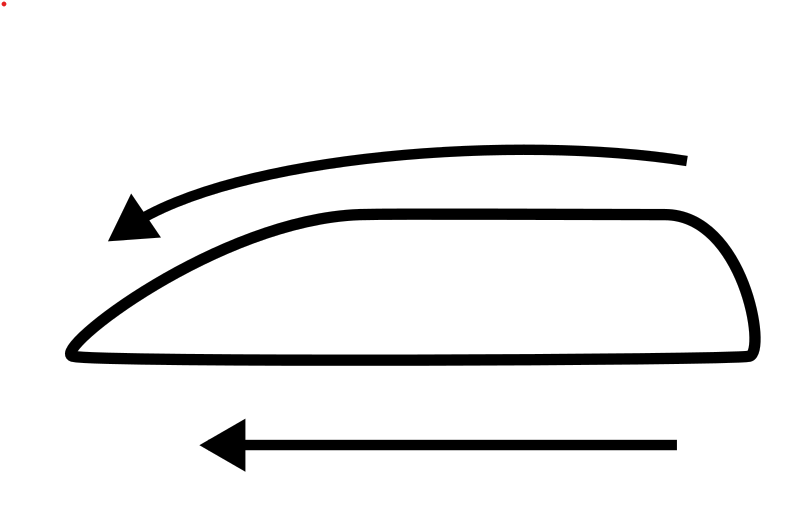
You might also hear there is a “top” and “bottom” side to a boomerang. The bottom of the boomerang is typically flat. This allows air to pass over that side of the boomerang faster, creating more pressure. The foil on the top of the boomerang guides the air in a slightly different direction. These airfoils create an aerodynamic lift that acts perpendicular to the relative airflow, counteracting gravity and sustaining the boomerangs flight, just like how an airplane wing generates lift.
An important reminder: we throw boomerangs nearly vertically, with the airfoil facing towards you, and the flat side facing away from you. This means the aerodynamic lift is initially pointing to your left for right-handed throwers.
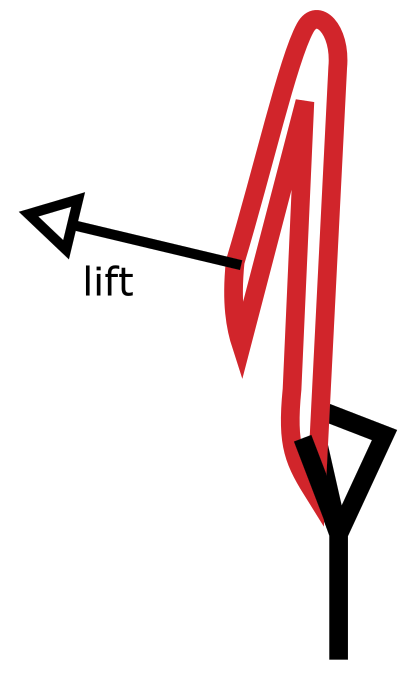
Another force at play here is gyroscopic precession. This phenomenon sounds fancy, but is seen in daily life. This force explains how a spinning top is able to stay upright, how a bike can be ridden with no hands, and even how the Earth spins!
Imagine you are riding a bicycle. The wheels are spinning around a bar that goes through their center. We call this bar a primary axis of rotation, because the wheels are rotating around this axis. Notice the wheels are spinning at an angle that is 90 degrees to their axis of rotation.
Now, if a bicycle cannot turn, it’s not very useful. We turn our bike by using a handlebar that is connected to the front wheel by its axis of rotation. When the axis turns, the wheel goes with it. Notice that the wheel is still spinning 90 degrees to the axis! This is because of its angular momentum. This force is what keeps the wheel stable and spinning, and points along the primary axis of rotation. The direction of this force depends on the direction the wheel is spinning. A rule of thumb is to use your right hand and give a thumbs up, with your fingers curled in the direction of the rotation. Your thumb will be pointing in the direction of the angular momentum!
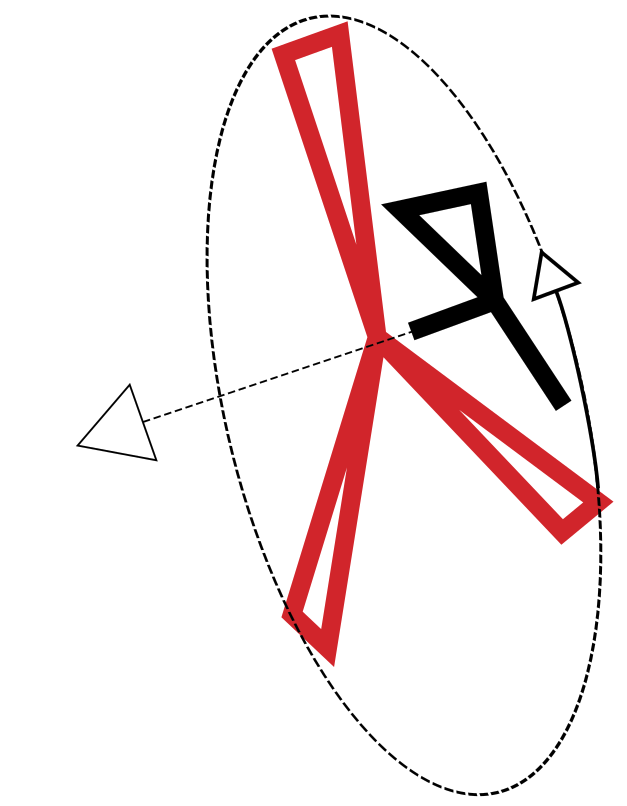
The same concepts apply with boomerangs!
When we throw a boomerang, it will rotate around its center of mass, which is its primary axis of rotation. There is an angular momentum that points perpendicular to the spin of the boomerang. There is also the aerodynamic lift that points perpendicular to the airflow, which is close to, but slightly different than the direction of the angular momentum. This is why you need to throw with the airfoils facing the same direction you want your boomerang to travel; if they are opposing each other these two forces will cancel each other out enough that your boomerang won’t come back!
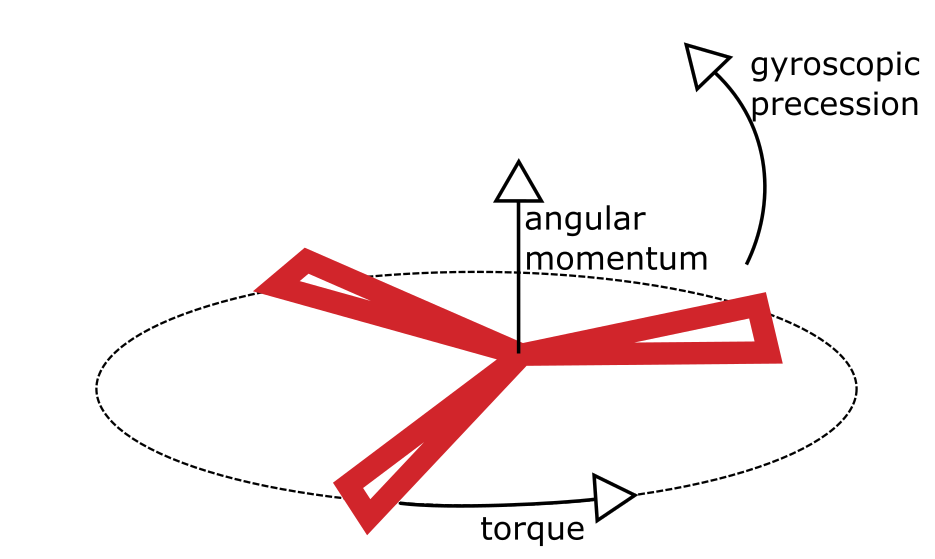
Now, you’ll notice something interesting happen when you throw a boomerang. When we throw them, you’ll notice that partway through the flight the boomerang will tip over, and it will return to you lying more flat, almost like a frisbee. Gyroscopic precession plays a role in this, but so does one more force we haven’t discussed yet.
The rotational force, or torque, is what causes the boomerang to tilt in its flight. In essence, the faster the boomerang is spinning, the greater the torque, but it’s important to note that a boomerang can have multiple values of torque acting upon it. A point at the end of the arm is moving faster than a point in the center of the boomerang, because there is more distance it needs to travel to make one full rotation in the same time. However, how the boomerang is oriented at a given moment also affects the torque, because there are two motions working here.
When we throw a boomerang, we throw it forward, giving it translational motion, but we also give it a spin, or a rotational motion. This means that the speed at which a boomerang is spinning relative to the air is different for each arm at a given moment. At the beginning of the flight, when the boomerang is vertical, the torque on a blade that is at the ‘top’ of the rotation is higher than a blade that is at the ‘bottom’ of the rotation, because though they have the same translational motion, the blade at the top of the rotation is also spinning in the same direction you threw it in, while the bottom blade is moving towards you.
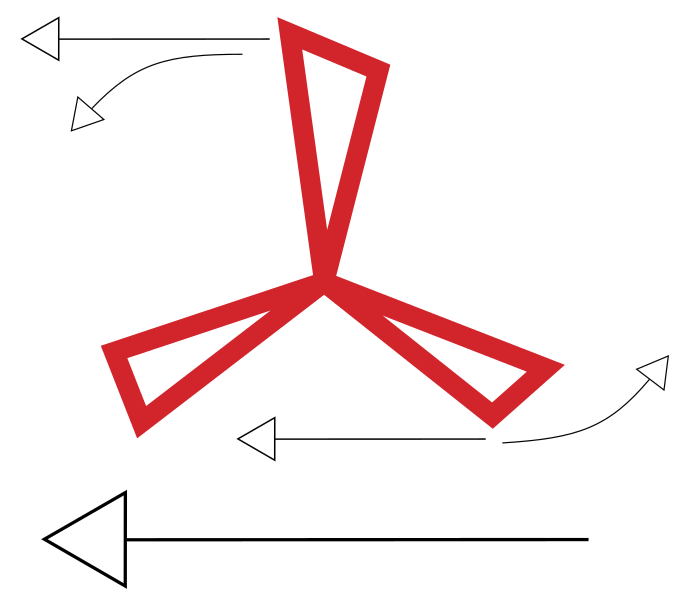
Lift is generated by the boomerang as it moves, and that lift is dependent on airspeed. And since we know each blade is moving at a different speed relative to the wind, we know each generates a slightly different lift. This difference, combined with gyroscopic precession, causes the boomerang to tilt and curve in its flight.
Now, the boomerang won’t keep turning over again and again, because as it lays out, the spin rate slows and the torque becomes more balanced. This is what makes the boomerang land more softly and have a slower translational motion, making it more catchable.
One last question, why does a boomerang continue to move after it lays over?
There is one more variable we should discuss… the wind!
You’ll find that boomerangs are more accurate if you throw with the wind hitting your left shoulder. We throw this direction so the wind can carry the boomerang that final distance back to you. You’ll also notice that in higher winds, the boomerang tends to go further, and we don’t want to have to run after them all the time. This is why you’ll see throwers add drag, generally in the form of rubber bands, in order to get the boomerang to drop faster.
Quick throwing tip: this means if a boomerang lands in front of you, you should throw more left, so the wind can carry it back to you more directly, and if the boomerang lands behind you, you need to throw more to your right.
To get a little into the weeds, the idea that the aerodynamic lift is perpendicular to the airflow is why you’ll see more aggressive airfoils for shorter range boomerangs, and more gentle foils for those you want to go further or have fall more gently, such as an Aussie Round or Trick Catch boomerang.
Now that you know the science, watch it in action with your own boomerang!